martial arts school management softwareMay 22, 20260 Comments
If you’re evaluating martial arts school management software for the first time — or considering a switch from what you’re currently using — the options can feel overwhelming. Most platforms look similar on the surface: member management, billing, attendance tracking, scheduling. The feature lists blur together.
But spend time running a martial arts school and you quickly discover that not all software is built the same way. Some platforms are generic gym management tools adapted for martial arts as an afterthought. Others are built specifically for how dojos actually operate — the belt system, the testing cycle, the instructor-student relationship, the retention dynamics that are unique to this community.
This guide is written for school owners who want to cut through the noise. Here’s what actually matters when evaluating martial arts school management software — and why it matters.
1. Is It Built for Martial Arts or Adapted for It?
This is the first question to ask — and the answer tells you a lot about everything else.
Generic fitness management software can handle memberships and billing. But it doesn’t understand belt levels. It doesn’t know that an orange belt promotion is a statistically significant attrition risk. It doesn’t connect attendance at a specific belt level to test readiness. It doesn’t know what a Kukkiwon certification means or why a student’s third late payment email needs to be different from their first.
Martial arts school management software built specifically for this world handles all of that — not as custom workarounds, but as core features designed around how schools actually operate. When evaluating any platform ask: was this built for martial arts, or was martial arts added to something that was built for something else?
2. Does It Handle the Complete Belt Testing Cycle?
Belt testing is one of the most operationally complex things a martial arts school does — and it happens every two to three months. It’s also one of the most significant revenue events and one of the most powerful retention and engagement moments in a student’s journey.
Basic software tracks belt levels. Good software manages the complete end-to-end process.
Here’s what a complete belt testing workflow should include: attendance tracking at each belt level connected to a recommended threshold so the school owner knows who is ready to test. A curriculum of skills — defined by the school for their specific discipline — that instructors grade during the test on iPad or phone. Multiple instructors grading simultaneously during the test. Parents watching grades appear in real time through a member portal. Automatic collection of testing fees when a student qualifies. A professional PDF report card generated and emailed to the parent within minutes of the test ending — including the student’s photo, school logo, skill grades, instructor comments, and a belt certificate.
That’s not belt tracking. That’s belt testing management. Ask any platform you evaluate exactly how much of that process they handle and where it breaks down.
3. How Does It Handle Attendance — And What Does It Do With That Data?
Every martial arts school management platform tracks attendance. The question is what happens after the check-in.
Attendance data should connect to at least three things: belt test readiness — tracking classes attended at the current belt level against a recommended threshold; retention alerts — flagging students whose attendance pattern has softened before they drift into cancellation; and class performance — showing the school owner which programs are growing, which time slots are thinning, and where scheduling adjustments might be needed.
If attendance is just a number that sits in a student profile with no connection to testing or retention, the software is doing the minimum. Look for platforms where attendance data flows through the entire operation.
4. How Does It Handle the Trial-to-Member Conversion?
Trial conversion is where schools lose the most revenue they never knew they had. A student attends two or three classes, has a perfectly fine experience, and drifts away without converting. No system flagged them. No close conversation happened. The school owner finds out weeks later.
Good software turns the trial period into a structured process. It tracks which class the trial student is on, grades their skills during the trial period, and gives the school owner the data and tools to have a genuine close conversation on the last trial class — not a generic pitch, but a specific assessment of that student’s strengths and the journey ahead.
Ask any platform: what does your trial conversion workflow look like? If the answer is “we track whether they converted,” that’s not a workflow. That’s a report.
5. What Does It Do About Retention — Proactively?
The martial arts industry loses 20 to 30 percent of students every year. Most software addresses this reactively — a student hasn’t been in for 21 days, an email goes out. By then the student is often already mentally gone.
The best martial arts school management software identifies retention risk proactively — before the student has stopped coming, while there’s still time for a personal conversation to make a difference. This means watching behavioral patterns: attendance softening after a promotion, a teen reducing class frequency, an adult who missed two consecutive weeks. Each of these is a signal worth acting on weeks before they become an absence.
Ask any platform: at what point does your system flag an at-risk student? If the answer is after a defined period of absence, the intervention is already late.
6. How Does It Handle Billing — And Who Keeps the Money?
There are two fundamentally different billing models in martial arts software. In the first model the software company processes all tuition on behalf of the school, takes a percentage — typically four to ten percent — and remits the balance at the end of the month. In the second model the school owns its own billing, payments go directly to the school, and the software charges a flat monthly fee.
The math is straightforward. A school processing $30,000 per month at five percent is paying $1,500 per month — $18,000 per year — to a software company whose revenue scales with the school’s success. A flat monthly software fee is predictable regardless of how much revenue the school generates.
Beyond the cost, ask about pass-along fee capability — can the school pass credit card processing fees to members? This single feature can return $8,000 to $12,000 per year to a school doing typical tuition volumes. Not every platform offers it.
7. Does It Use AI — And Is the AI Useful?
AI is everywhere in software marketing right now. The question is whether the AI does something genuinely useful or whether it’s a label on an automated report.
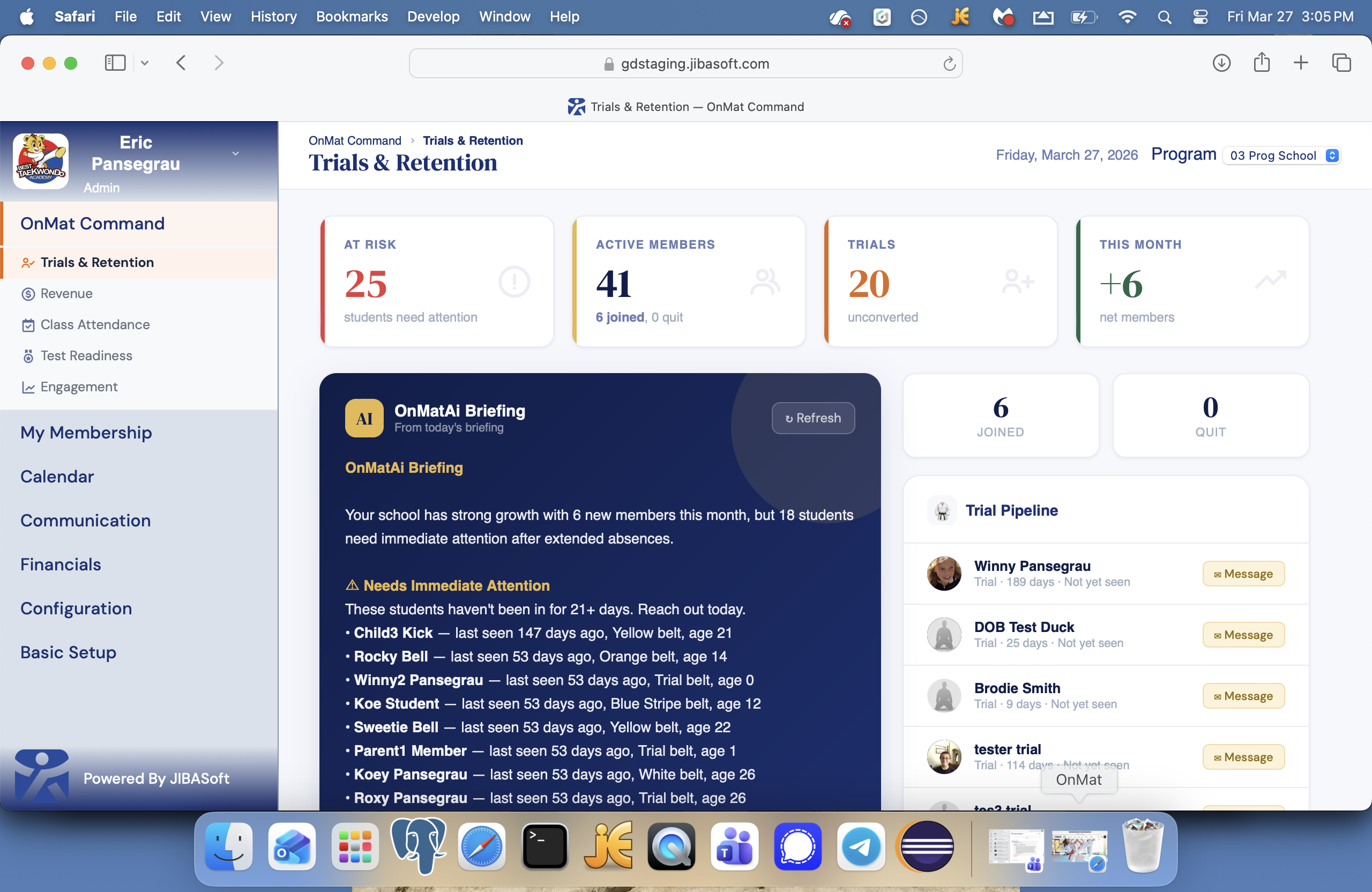
Useful AI in martial arts school management reads your school’s actual data every day and tells you what needs your attention — which students are drifting, which trials are stalling, which classes have low turnout, and what specific action to take. It generates personalized content that sounds like it came from your school — not a template. It identifies behavioral patterns that a human looking at a dashboard would miss.
Ask any platform: what does your AI actually do, and what data does it read to do it? The answer will tell you whether the AI is a feature or a marketing term.
8. Can Your Members Onboard Themselves?
One of the most common reasons schools delay switching software is the migration — collecting member data, formatting CSVs, importing records, fixing errors. It can take days for a school with 150 members.
Modern martial arts school management software eliminates this entirely through member self-registration. A QR code or URL sent to existing members lets them register themselves in under two minutes — entering their own information, adding family members, and vaulting their payment method. The data is accurate because the member entered it. The school owner spent zero staff hours on the migration.
Ask any platform how they handle onboarding existing members. If the answer involves a CSV template, factor that migration time into your evaluation.
9. Is Support From Real People Who Understand the Business?
Martial arts school management software is not a commodity. When something goes wrong before a belt test or during billing week the school owner needs a real response from someone who understands what’s at stake.
Ask what the guaranteed response time is. Ask whether support goes to a ticket queue or a person. Ask whether the people providing support have any background in the martial arts industry or are purely technical staff reading from a script.
Support quality is invisible until you need it — and when you need it, it’s the only thing that matters.
What the Best Martial Arts School Management Software Looks Like
Putting all of this together, the best martial arts school management software is built specifically for martial arts, handles the complete belt testing cycle from readiness to report card, connects attendance data to testing and retention, supports a structured trial conversion process, identifies at-risk students proactively, keeps the school’s money in the school’s account, uses AI that reads real data and takes real action, eliminates the migration burden through self-registration, and provides support from people who understand the business.
That’s a high bar. Not every platform clears it. Evaluating software against these criteria rather than feature lists will lead you to the right decision faster.
Try OnMat free for 30 days. No credit card required. No setup fee. No contract.
Want to see how OnMat addresses each of these criteria? Explore OnMat’s full feature set, read about end-to-end belt testing, attendance tracking, martial arts billing, or contact our team — we respond within 24 hours.
Frequently Asked Questions
What is the best martial arts school management software?
The best martial arts school management software is built specifically for martial arts — not adapted from generic gym software. It should handle the complete belt testing cycle, connect attendance to test readiness, support proactive retention, keep billing in the school’s control, and use AI that reads real school data. OnMat was built by martial artists specifically for this world and has served schools across the United States since 2015.
What features should martial arts school management software include?
Essential features include member management, automated billing with pass-along fee capability, attendance tracking connected to belt test readiness, end-to-end belt testing with report cards, trial conversion tools, proactive retention alerts, member self-registration via QR code, and a parent and student portal. AI-powered daily briefings are increasingly important for school owners managing 100 or more students.
How much does martial arts school management software cost?
Pricing varies significantly by model. Some platforms charge a flat monthly subscription — OnMat starts at $79 per month. Others take a percentage of tuition, typically four to ten percent, which can cost $1,500 or more per month for a school processing $30,000 in tuition. Evaluate total cost including processing fees, not just the headline subscription price.
Is there martial arts school management software with AI?
OnMat includes Claude AI integration across its full feature set — daily school briefings that read attendance, billing, and engagement data, AI-generated trial conversion reports personalized to each student, and AI-powered retention alerts that identify at-risk students months before traditional software would flag them. The AI adapts to each school’s voice and philosophy.
How long does it take to switch martial arts school management software?
With OnMat’s self-registration feature, existing members onboard themselves via QR code or email link in under two minutes. Most schools have their full member list in the system within 48 hours of sending the registration link — with no CSV imports, no data entry by staff, and no migration project.