martial arts school management softwareMay 19, 20260 Comments
In the early 1980s, a 16-year-old stopped coming to martial arts class. Life got in the way — the way it does at 16. He didn’t quit dramatically. He just drifted. Stopped showing up. Figured he’d get back to it someday.
His master called him.
Not an automated email. Not a mass text. A phone call. Two minutes. “Hey — haven’t seen you in a few weeks. Everything okay?”
That 16-year-old is Eric Pansegrau — founder of OnMat and a black belt today. Decades later, he returned to the mat around 2010 as a student, then became an instructor at a school in California where he taught until COVID-19 shut the world down in March 2020. He never took a paycheck. He instructed because he loved it.
He enrolled his own children in taekwondo at ages four and five. His daughter earned her Kukkiwon black belt at 12. His son reached brown belt before the pandemic ended their training.
The moments he remembers most from those years aren’t the promotions or the belt tests. They’re the essays — required at his school when students tested for black belt — where students wrote about their journey and often recalled something an instructor had said to them as a white belt, years earlier, that stayed with them all the way to black belt.
“Those essays brought me to tears every time,” said Pansegrau. “A student remembers something you said in their first week of class, years later, at the most important moment of their martial arts journey. That is the relationship this community is built on. Honor exists to protect it.”
For years, the question that shaped OnMat’s development was the same one that had followed Pansegrau since the 1980s: what if his master hadn’t called?
OnMat Honor is built to make sure that call never gets missed.
The Problem Every School Owner Knows
The martial arts industry loses 20 to 30 percent of students every year. School owners feel it before it shows up in the numbers — the student whose attendance softens slightly, the teenager who seems a little less engaged after promotion, the adult who missed two classes and hasn’t rescheduled. By the time a traditional at-risk report surfaces their name, they’re often already gone.
The problem isn’t that instructors don’t care. Every instructor cares. The problem is scale. When you have 60, 100, or 200 active students, you cannot personally track every signal from every student every week. Things get missed. Not because the school owner stopped paying attention — but because there is genuinely too much to watch and not enough of one person to watch it all.
OnMat Honor is designed for exactly that problem.
What OnMat Honor Is
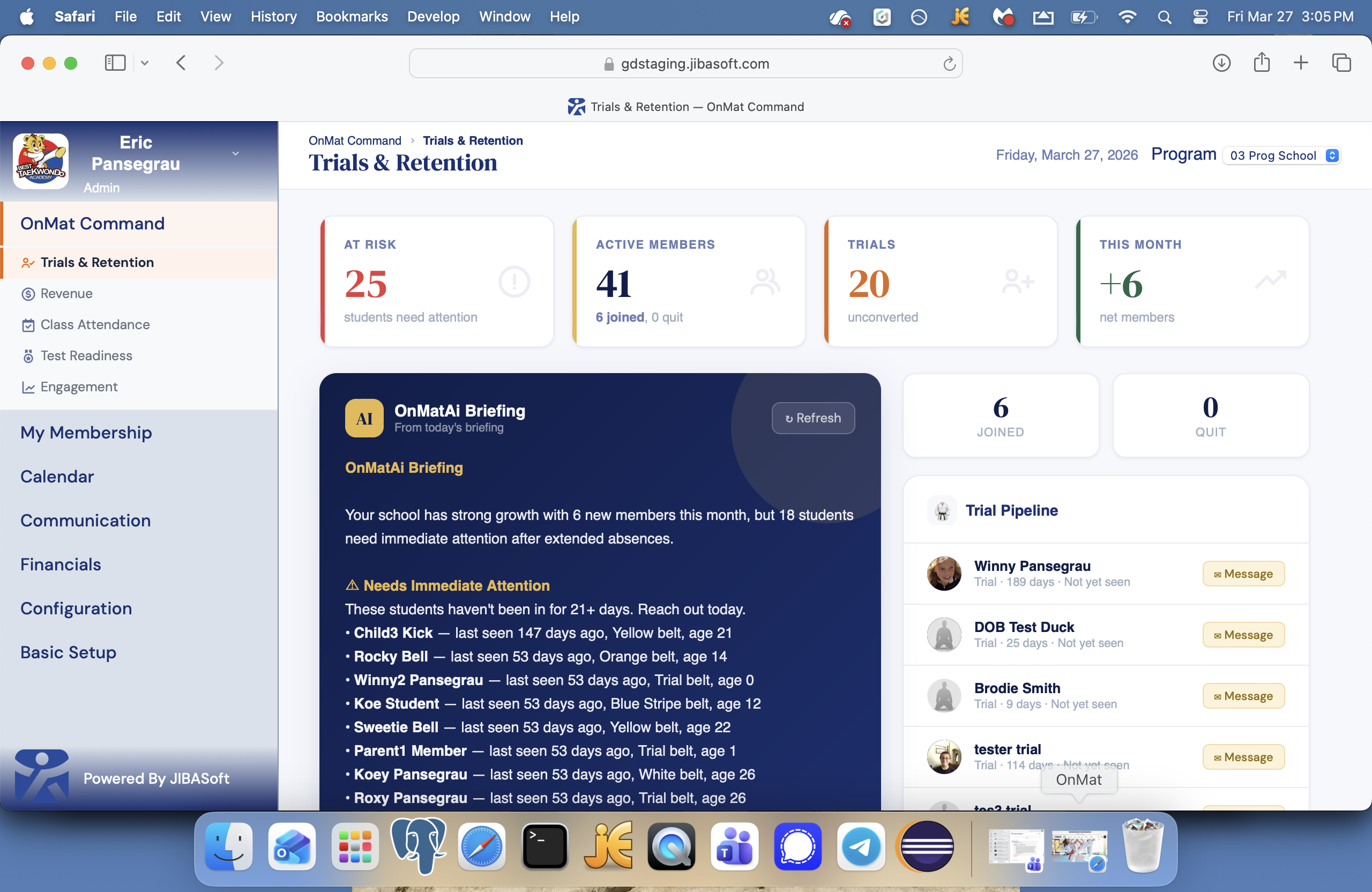
OnMat Honor is a leadership tool built into OnMat Command — the same dashboard where school owners already see their daily school briefing, belt testing readiness, their trial pipeline, and their attendance data. Honor watches every student’s attendance pattern, belt journey, and engagement signals, and surfaces the exact moment when a student is beginning to drift — usually months before they would appear on any traditional at-risk list.
It tells the school owner what’s happening, why, and what specific action to take.
Students earn honor for showing up, building streaks, mastering skills, earning promotions, and helping each other. They redeem honor at the school store — physical items the school stocks, or experiential rewards that cost the school nothing but mean everything to the student. A free private lesson with their instructor. Choose the warmup song. Lead the class bow.
But the points are not the product. The school owner’s attention is the product. Honor exists to make sure that attention lands on the right student, at the right moment, with enough context to act.
Rocky Bell
Rocky Bell is 14 years old. Orange belt. He’s been training for 11 months — consistent, three times a week, the kind of student an instructor notices in a good way. After his orange belt promotion, he put together an 8-week attendance streak. Then something shifted. His attendance dropped from three times a week to twice a week. Still active. Still showing up. But the pattern changed.
In most schools, nobody notices. Rocky keeps attending a little less. Eventually he misses a week. Then two. By the time he shows up on an at-risk report, he’s been gone 21 days and the email that goes out doesn’t get answered. After 102 days, he’s a name on a list of lapsed students. Another one the school owner meant to follow up with.
With OnMat Honor, the system surfaces Rocky’s pattern shift to the school owner five months earlier — while he’s still attending twice a week. The OnMatAi morning briefing says: “Rocky Bell, 14, orange belt. Pattern: teen drift after elevated-risk promotion. Attendance softened 30% over the last month. Call him directly — not the parents.”
The school owner has a 30-second conversation with Rocky after class on Saturday. “Hey — missed you Tuesday. Everything okay?”
Rocky stays.
The retention value is not in the dramatic save at 100 days. It’s in the quiet, weeks-earlier moment that costs the school owner almost nothing and saves the student. That’s the conversation OnMat Honor is designed to make happen.
Why This Is Different
There are software products that bolt a points system onto their platform and call it engagement. OnMat Honor is not that. Three things make it different.
First, it puts the school owner at the center. The system’s primary user is the school owner or head instructor — whatever title they carry in their discipline. Students experience recognition. The school owner gets a leadership tool. Every design decision reflects the instructor’s role as the singular authority in their school. Honor serves the instructor. The instructor serves the student.
Second, it is intervention-oriented, not rewards-oriented. Most points systems give out points. OnMat Honor uses behavior patterns to surface the right moment for the school owner to act. The honor students earn is real and meaningful. But the deeper purpose is to give the school owner a reason to have the right conversation at the right time.
Third, it is built on real martial arts data. OnMat has been collecting attendance, belt progression, and attrition patterns from schools since 2015. The intervention patterns in Honor are not theoretical. Orange belt is a known attrition peak. Red and brown belt is a second peak. Teens drift differently than young children. Adults leave for different reasons than either. Honor knows these patterns because OnMat has watched them play out across hundreds of students over years.
What Honor Is Not
There are no public leaderboards in OnMat Honor. This was a deliberate decision. Public leaderboards reward the students who are already engaged — the ones who don’t need the system’s help. They demotivate the marginal student, the one who is quietly drifting, the one who is exactly the population Honor exists to retain. Honor is oriented toward personal progress, not competition between students.
Honor is also not a children’s feature. It scales from six-year-old Little Tigers to adults in their fifties. The intervention patterns adapt by age. What works for a 10-year-old green belt is different from what works for a 35-year-old white belt. Honor knows the difference.
And Honor is not a generic loyalty program dressed up for martial arts. It is built specifically for this world — the belt progression, the instructor-student relationship, the cultural values that make martial arts different from every other fitness business. A taekwondo school owner, a BJJ professor, a karate sensei, a kung fu sifu — the titles differ, the traditions differ, but the retention problem is the same. Honor is built for all of them.
The “Engagement” Placeholder
Existing OnMat customers who have clicked on the Engagement section of OnMat Command have seen a “Coming Soon” message for some time. Honor is what it was waiting to become. The placeholder has been there because the team was not going to ship something until it was worth shipping. Honor is ready.
What the School Owner’s Morning Looks Like Now
The school owner opens OnMat Command. The OnMatAi briefing tells them: three students are approaching their streak milestone this week — a brief acknowledgment on the mat would mean a lot. One student came back after a three-week absence — the comeback bonus is already credited, but a personal welcome back tonight reinforces it. And Rocky Bell’s pattern has shifted — call him directly today.
That briefing takes 90 seconds to read. The actions it recommends take minutes to complete. The retention impact compounds over months and years, one student at a time.
That is what OnMat Honor is built to do.
Every school owner has lost students they could have saved if they’d reached out at the right moment with the right approach. OnMat Honor exists to make sure those moments don’t get missed again.
OnMat Honor is available now in the Academy tier. Try OnMat free for 30 days — no credit card required, no setup fee, no contract.
Already an OnMat customer? OnMat Honor is waiting for you in OnMat Command under the Engagement section. Contact our team if you have questions — we respond within 24 hours.